

Two of the most common ailments are peripheral arterial disease (PAD) and chronic venous insufficiency (CVI). Millions of people worldwide live with these diseases.
Both diseases involve the blood vessels. But: do you know the key differences between PAD and CVI?
This post discusses signs, symptoms, and treatment options for both PAD and CVI. This is a great place to start educating yourself.
However, if you suspect you have arterial or venous insufficiency, talk to your healthcare provider. You’ll want to take control of your health before either PAD or CVI worsens.
What is Peripheral Arterial Disease?
Patients with peripheral arterial disease, or PAD, have poor circulation in their lower legs. Plaque restricts arterial blood flow, causing pain in the calf or thigh. This pain can make walking difficult.
Peripheral arterial disease is most commonly caused by fatty material in the arteries. Less common causes include injuries, radiation, or blood vessel inflammation(2).
PAD affects more than 200 million adults worldwide(1). Some risk factors for PAD include(3):
- Ethnicity
- Diabetes
- Obesity
- Smoking
- Hypertension
- Increased age
- Family history of PAD, heart disease, or stroke
- High blood levels of homocysteine
- High cholesterol levels
Signs and Symptoms of Peripheral Arterial Disease

If you have PAD, you might experience pain in the lower legs that worsens while walking. Your legs may also feel crampy, heavy, or tired.
Patients with mild to moderate PAD may have little to no symptoms. This depends on where in the leg the PAD has occurred (if in a major artery or a minor one) or how active the patient is.
Patients with severe peripheral arterial disease may experience pain even while resting or not be able to heal a toe or foot wound. Patients with severe pain usually relieve their symptoms by dangling their legs.
Other side effects include paleness, a decrease in muscle, hair loss, or cool skin,
Peripheral Arterial Disease Diagnosis
To diagnose PAD, your doctor will perform a physical exam. They will take your blood pressure above your ankle and on both arms. (This is an ankle-brachial index, or ABI.) They may also perform ultrasound exams to locate the site of the artery issues and its severity.
Treatments for Peripheral Arterial Disease
Patients with PAD should focus on lifestyle and mobility improvement. Doctors recommend exercise and a diet low in cholesterol and to avoid smoking. It is also important to manage certain conditions simultaneously, like diabetes or hypertension. This can help improve PAD symptoms(5).
Your doctor may also prescribe medications like cilostazol to improve circulation.
Catheter based outpatient angiographic endovascular procedures may be recommended to “clear” the leg artery blockages.
What is Chronic Venous Insufficiency (CVI)?
Chronic venous insufficiency is a disease that causes edema in the lower legs, skin changes, and discomfort. Patients also may have venous ulcers, which can be painful, and nonhealing.
Chronic venous insufficiency affects 30 million people in the United States(6).
How Does Chronic Venous Insufficiency Occur?

Chronic venous insufficiency occurs due to reflux or obstruction of venous blood flow. This backward flow stems from a weakened, expanded, or oddly shaped valve. In almost all cases, CVI leads to venous hypertension.
Patients may experience pain, swelling, and even hyperpigmentation. They may also experience lipodermatosclerosis: when the skin thickens due to fat fibrosis. And, as the skin continues to weaken, ulcers may form.
Signs and Symptoms of Chronic Venous Insufficiency
Patients with CVI may experience lower leg swelling, discomfort, pain, fatigue, and itching. Some may complain of cramping or throbbing feeling relieved by resting or elevating their legs.
Unlike peripheral arterial disease, this pain is not associated with any activity.
Chronic Venous Insufficiency Diagnosis
To diagnose CVI, your doctor will review your medical history and they will also perform a physical exam.
A duplex ultrasound of your leg veins can help identify affected regions.
Treatment for Chronic Venous Insufficiency
Patients with chronic venous insufficiency are treated based on disease severity.
Treatments for CVI aim to:
- Reduce leg discomfort or pain
- Reduce swelling
- Treat painful varicose veins
- Heal ulcers and avoid infection
In early stages, patients may regularly elevate their legs, do calf exercises, and wear compression stockings.
Ulcers are treated with compression dressings and bandages. Compression bandages should be used with caution if PAD coexists.
Patients with superficial vein reflux may benefit from Radiofrequency Ablation (RFA,) Varithena or Microphlebectomy.
Compression therapy is highly effective for managing CVI if a patient keeps at it.
The Differences Between PAD and CVI
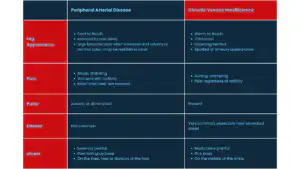
Peripheral arterial disease and chronic venous insufficiency may seem similar. However, there are key differences between these two diseases. We’ve summed up these differences in the chart below:
Conclusion
If you have any of the symptoms described in this post, don’t wait to get help. Whether it’s PAD, or CVI, getting a proper diagnosis is the first step toward a healthier you and improving your quality of life.
AMS Vascular is here to help. Book your consultation today!
References
- Zemaitis MR, Boll JM, Dreyer MA. Peripheral Arterial Disease. [Updated 2020 Jul 10]. In: StatPearls [Internet]. Treasure Island (FL): StatPearls Publishing; 2020 Jan-. Available from: https://www.ncbi.nlm.nih.gov/books/NBK430745/
- Simon F, Oberhuber A, Floros N, Düppers P, Schelzig H, Duran M. Pathophysiology of chronic limb ischemia. Gefasschirurgie. 2018;23(Suppl 1):13-18.
- Jelani QU, Petrov M, Martinez SC, Holmvang L, Al-Shaibi K, Alasnag M. Peripheral Arterial Disease in Women: an Overview of Risk Factor Profile, Clinical Features, and Outcomes. Curr Atheroscler Rep. 2018 Jun 02;20(8):40
- Kim HO, Kim W. Elucidation of the Diagnosis and Treatment of Peripheral Arterial Disease. Korean Circ J. 2018 Sep;48(9):826-827.
- US Preventive Services Task Force. Curry SJ, Krist AH, Owens DK, Barry MJ, Caughey AB, Davidson KW, Doubeni CA, Epling JW, Kemper AR, Kubik M, Landefeld CS, Mangione CM, Silverstein M, Simon MA, Tseng CW, Wong JB. Screening for Peripheral Artery Disease and Cardiovascular Disease Risk Assessment With the Ankle-Brachial Index: US Preventive Services Task Force Recommendation Statement. JAMA. 2018 Jul 10;320(2):177-183.
- Patel SK, Surowiec SM. Venous Insufficiency. [Updated 2020 Aug 15]. In: StatPearls [Internet]. Treasure Island (FL): StatPearls Publishing; 2020 Jan-. Available from: https://www.ncbi.nlm.nih.gov/books/NBK430975/
- Knupfer J, Reich-Schupke S, Stücker M. [Conservative management of varicosis and postthrombotic syndrome]. Hautarzt. 2018 May;69(5):413-424