

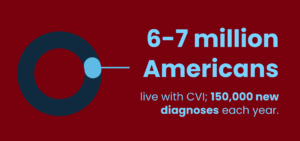
30 million people in the United States live with chronic venous insufficiency. Around 150,000 new people are diagnosed every year(1).
Chances are that someone you know has this condition – or that someone may even be you!
Chronic venous insufficiency may be known for its symptoms: leg swelling, skin changes, and discomfort. But chronic venous insufficiency can be a sign of something worse down the road. It’s important to familiarize yourself with this condition.
Let’s learn how to identify chronic venous insufficiency: the causes, signs, symptoms, and treatment options.
How does chronic venous insufficiency start?

Chronic venous insufficiency is classified as either primary or secondary:
Patients with primary chronic venous insufficiency may be born with the condition. They might have abnormal vein walls or less elastin, which means their veins don’t stretch as well as others. In any case, these issues are out of one’s control and do not stem from another condition.
Secondary chronic venous insufficiency is, well, secondary to another condition. And it often develops because the patient already has deep vein thrombosis.
Deep vein thrombosis, or DVT, is a disease where blood clots form in the veins, usually in the legs(3). DVT triggers inflammation, causing damage to vein walls. This causes secondary chronic venous insufficiency.
Someone may have an increased risk of developing CVI if they are female, obese, or pregnant. Smoking also increases risk. Prolonged standing and having May-Thurner syndrome do as well(1).
The veins bring blood back to the heart, pushing blood upwards from the legs. To do this, the muscles of the calves and the valves of the veins work together.
However, chronic venous insufficiency patients may experience leaks or obstruction in the veins. This results in a pressure increase in the lower extremities. Blood flow, vein blockages, valves, and calf muscles all impact pressure.
When CVI is secondary to DVT, repeated vein wall injury from DVT causes the veins to scar. These scars narrow the blood passageway, increasing venous pressure.
Chronic Venous Insufficiency Symptoms
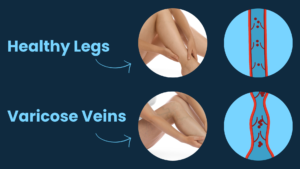
Patients with CVI experience pain, leg discomfort, ankle and leg swelling, or itching. They may also feel “prickling,” cramping, or heaviness in the lower limbs after standing too long(4).
In severe cases, ulcers, pigmentation, thickening, and wound healing delays are possible. Ulcers near the ankles may especially have trouble healing.
Diagnosis of Chronic Venous Insufficiency
To diagnose chronic venous insufficiency, the doctor might ask if:
- You’ve ever been pregnant
- You have a family history of CVI
- Your job involves heavy lifting or prolonged standing
They will also review your full medical history. They’ll look for conditions like obesity and hypertension. The doctor will also examine your legs, noting size, texture, and color.
If they suspect CVI, you might receive more testing. One example is the venous duplex ultrasound scan. This is one of the best way to locate problematic veins(6)
Chronic Venous Insufficiency Classification
Clinical, Etiology, Anatomic, and Pathophysiology (CEAP) classification helps physicians consistently identify and treat vein disease(8):
- Clinical (C) classification divides vein disease into categories of severity based on symptoms.
- Etiologic (E) helps describe the disease’s cause.
- Anatomic (A) identifies which veins are insufficient.
- Pathophysiological (P) helps identify how the disease impacts the body. (Examples include reflux, thrombosis, or obstruction.)
Doctors also classify CVI with Venous Clinical Severity Scoring, or VCSS. VCSS uses different attributes to identify disease severity: absent, mild, moderate, or severe. This is often used in assessing the patient’s response to treatment(8).
Table 1.CEAP Classification. (8)
Chronic Venous Insufficiency Treatments
CEAP classification and VCSS will identify CVI severity. From there, the doctor will recommend treatment.
The goal of treatment is to improve circulation and prevent further vein damage. Treatments might also focus on reducing swelling, healing venous ulcers, and managing pain.
Treatments include:
Lifestyle changes
Smoking causes several health problems, including vein issues. Smoking restricts the blood flow in our lower limbs. Nicotine also impacts vein elasticity. Stopping a smoking habit can greatly improve your vein health.
Eating a balanced diet is also crucial. Extra weight on your body can add extra stress on your legs, worsening symptoms.
Blood flow improvements
Elevating your legs can help improve blood flow. Try sitting with the legs raised above the thighs or lying down with the legs above your heart. This also reduces leg swelling.
Another way to improve blood flow is to do regular exercises. Rehabilitation through exercise is also available. CVI patients saw improvements in 5 months after regular calf muscle exercise(10).
Compression stockings are a standard treatment for helping to restore venous blood flow. Compression is greatest around the ankle. This pressure decreases as you move up the leg, aiding blood flow(9).
Medications
The US Food and Drug Administration has not approved any medications for CVI. Medications may be prescribed to treat side effects.
Horse chestnut seed extracts, French maritime pine bark extract, and flavonoids can help(2).
Venous Ablation
Venous ablation is a minimally invasive treatment for chronic venous insufficiency (CVI) and venous reflux disease. It works by closing diseased veins so blood is redirected through healthier veins, helping relieve symptoms and improve circulation. Treating these refluxing veins may also promote ulcer healing and reduce the progression of vein disease.
Before treatment, an ultrasound evaluation is performed to map the veins and ensure the safest and most effective treatment plan.
Radiofrequency Ablation (RFA) uses heat delivered through a small catheter to seal the affected vein. It is a minimally invasive outpatient procedure with a quick recovery, and most patients return to normal activities the same day.
Varithena® is a type of non-thermal venous ablation that uses a specialized foam to seal diseased veins. It is effective for treating a wide range of varicose veins and typically involves little downtime.
Chronic Venous Insufficiency Complications
The most common CVI complications include:
- Chronic leg pain
- Swelling
- Dry itchy skin at the ankles (venous dermatitis)
- Non-healing leg ulcers
Conclusion
Chronic venous insufficiency is nothing to make light of. Leaving CVI untreated can lead to disability down the road.
If you’re ready to take charge of your vein health, the experts at AMS Vascular are ready to help. Our team is here to provide solutions for chronic venous insufficiency. Our vein experts are professional and patient-focused, providing top-of-the-line care and modern treatments like Radiofrequency Ablation, Varithena, and Microphlebectomy.
Take the first step toward a healthier you. Book your consultation today!
References:
- De Popas, E., & Brown, M. (2018). Varicose Veins and Lower Extremity Venous Insufficiency. Seminars in interventional radiology, 35(1), 56–61. https://www.thieme-connect.de/products/ejournals/abstract/10.1055/s-0038-1636522
- Jameson, J. L., Kasper, D. L., Longo, D. L., Fauci, A. S., Hauser, S. L., &Loscalzo, J. (2018). Harrisons principles of internal medicine 20th edition. New York: McGraw-Hill Education.
- Waheed, S. M., Kudaravalli, P., &Hotwagner D. T. (2020). Deep vein thrombosis. StatPearls.Treasure Island: StatPearls Publishing
- Spiridon, M., &Corduneanu, D. (2017). Chronic Venous Insufficiency: a Frequently Underdiagnosed and Undertreated Pathology. Maedica, 12(1), 59–61.
- Bounds E. J., Sankar P., Kok S. J. (2020) D imer. StatPearls. Treasure Island: StatPearls Publishing
- Necas M. (2010). Duplex ultrasound in the assessment of lower extremity venous insufficiency. Australasian journal of ultrasound in medicine, 13(4), 37–45.
- Tamura, K., & Nakahara, H. (2014). MR Venography for the Assessment of Deep Vein Thrombosis in Lower Extremities with Varicose Veins. Annals of vascular diseases, 7(4), 399–403. https://www.jstage.jst.go.jp/article/avd/7/4/7_oa.14-00068/_article
- Eberhardt, R. T., &Raffetto, J. D. (2014). Chronic venous insufficiency. Circulation: Clinical Summaries. 130:293–294. https://doi.org/10.1161/CIR.0000000000000083
- Weiss, R., Anariba, D. E. Z., Lanza, J., &Lessnau, K. D. (2018). Venous insufficiency. Retrieved from https://emedicine.medscape.com/article/1085412-treatment
- Ombrellino, M., &Kabnick, L. S. (2005). Varicose vein surgery. Seminars in interventional radiology, 22(3), 185–194. https://doi.org/10.1055/s-2005-921951