

Do you have varicose veins? You’re not alone: 30% of adults in developed countries live with this condition(1).
Normally, veins are not very visible. But when we develop varicose veins, they begin to bulge. The veins in your lower legs might appear blue or purple.
Genetics can also play a large role in the development of varicose veins. Those in the latter group can have weaker vein walls, leading to varicose veins.
But what is the best way to treat varicose veins?
Compression therapy is the most recommended treatment(2). Read on to learn the basics of varicose veins and all you need to know about compression stockings.
Signs and Symptoms of Varicose Veins
The first step toward treatment is determining if you have varicose veins in the first place.
Patients with varicose veins might have the following symptoms:
- Bluish purple veins in your lower limbs
- Bumpy and bulging vein texture
- Skin changes near your veins, such as a “leathery” texture of discoloration
- Swelling of the lower limbs
- Venous ulcers or open lesions
You might not experience obvious symptoms at first. Pay close attention if you start to feel:
- Itchy lower limbs
- Heaviness in your legs
- Throbbing and burning of the swollen legs
- Pain in the lower limbs after prolonged sitting and standing
- Bleeding and ulceration from varicose veins
If you think you have varicose veins, make an appointment with your doctor. They can review your symptoms and determine the best treatment option.
Treatment of Varicose Veins
Depending on your disease, your doctor might recommend other treatments like Radiofrequency Ablation (RFA), Varithena, and Microphlebectomy.
Compression therapy is the easiest and most accessible, so starting there is best.
What is Compression Therapy?
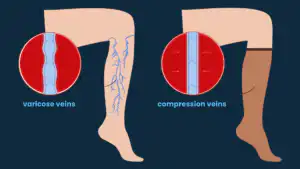
Compression therapy is a temporary method for alleviating symptoms of varicose veins, but it does not treat the underlying condition. It is a non-invasive treatment ideal for those looking to avoid surgical interventions. Options include elastic and non-elastic bandages, boots, hose, or stockings(5).
Compression therapy is also recommended for other ailments like lymphatic insufficiency, deep vein thrombosis, and post-thrombotic syndrome(5).
How Do Compression Stockings Work?
Compression stockings exert pressure on the lower legs. They are typically tightest at the ankles and loosen up the leg(5). This gradient pressure keeps blood from flowing downward.
Unlike arteries, veins are compressible. Compression decreases vein diameter, increasing the speed and volume of blood flow(6). The stockings can also reduce inflammation(5), pain, heaviness, and swelling (7).
Types of Compression Stockings
Graduated or medical compression stockings
Graduated compression stockings squeeze the legs. They are available in different styles and pressure amounts.
Stockings can be knee- or thigh-high and made of different materials. They are elastic or inelastic.
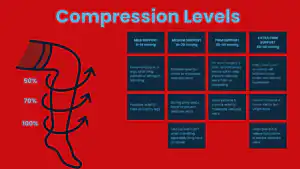
While there are no formal pressure standards, they are generally grouped into four levels(8).
Understanding Compression Levels
What medical conditions do different compression levels address? Here’s an overview. These are general recommendations, and the severity of the condition will help determine the appropriate compression level.
Always consult your doctor to determine the right compression level for your needs.
8-15 mmHg
- Mild leg discomfort or tiredness
- Provides support and comfort for long periods of standing or sitting
- Ideal for general health and energy with light support
15-20 mmHg
- Slightly more support for day-to-day relief from achy, heavy, or mildly swollen legs
- Extra support on busy days or while traveling
20-30 mmHg
- Most commonly prescribed compression level by doctors
- Reduces swelling from mild to moderate edema
- Often used after procedures like Radiofrequency Ablation (RFA), Varithena, and Microphlebectomy.
30-40 mmHg
- Provides relief from moderate to severe edema and lymphedema
- Treats phlebitis
- Addresses skin changes associated with healed ulcers
You can purchase lower-strength compression stockings without a prescription. However, finding the right size for comfort and effectiveness is important.
Elasticity, leg size and shape, and patient activity all impact stocking pressure(5).
Doctors recommend graduated compression stockings to manage varicose veins and chronic venous insufficiency. They can also help patients manage venous ulcers and manifestations of post-thrombotic syndrome.
When Do You Need Compression Therapy?

Compression stockings help with several conditions:
Varicose Veins
Compression stockings are a temporary method for managing the symptoms of varicose veins, but they do not treat the underlying condition. They improve circulation by reducing blood stasis. They may be a stand alone treatment or used in conjunction with radiofrequency ablation, Varithena, and Microphlebectomy. By minimizing inflammation, compression stockings can reduce blood clots and prevent skin discoloration (5).
Chronic Venous Insufficiency
Compression stockings are also recommended for those with venous insufficiency. They can improve skin conditions such as eczema, induration, and lipodermatosclerosis(10). At higher pressure levels, they can help reduce the recurrence of venous ulcers.
How to Effectively Use Compression Stockings

Some patients have trouble wearing compression stockings. They may experience sweating or itching, dislike the cost or cosmetic appearance of the stockings, or even experience edema exacerbation or lesion exudation(11). Some may struggle to put the stockings on.
But compression stockings are only effective if you wear them! Note the fitting, material, and compression level to ensure a good fit. Then you’ll be more likely to wear them.
To ensure the best fit, many medical supply stores have a licensed “fitter” who will measure your legs and recommend the best size for you.
Wearing and Maintaining Your Compression Stockings
Before putting stockings on:
- Hand wash your compression stockings so they are more flexible and easier to put on.
- The best time to put on your stockings is first thing in the morning when your legs are least swollen.
- If you have an open wound, make sure to dress it beforehand.
When it’s time to put on your stockings:
- Sit in a chair with a back.
- Grasp the top of the stocking with one hand and reach inside towards the toe part with your other hand.
- Roll the stocking inside out to avoid stretching.
- Slowly roll and slide the stocking onto your heel and pull upwards gradually.
- Take your time when putting your stockings on. This will make the process easier!
Conclusion
Compression stockings are still the first-line treatment for varicose veins. They increase blood flow, decrease blood volume, and reduce reflux and venous hypertension.
Wearing compression stockings can reduce inflammation and edema. Talk to your doctor to weigh the benefits and risks of using compression stockings.
Measurements and pressure amounts depend on the severity of your varicose veins. The worse your symptoms and disease, the stronger the degree of compression. It’s also important to wear your stockings to get the benefits of treatment.
Ready to seek treatment for your varicose veins? Connect with AMS Vascular. Our experts will evaluate your condition and medical history. From there, they will provide proper compression therapy guidance. Don’t wait one day longer to improve your vein health: book your consultation today!
References
- Shadrina, A.S., Sharapov, S.Z., Shashkova, T.I., & Tsepilove, Y.A. (2019). Varicose veins of lower extremities: Insights from the first large-scale genetic study. PLOS Genetics 15(4). https://doi.org/10.1371/journal.pgen.1008110
- National Clinical Guideline Centre (UK). (2013). Varicose Veins in the Legs: The Diagnosis and Management of Varicose Veins. London: National Institute for Health and Care Excellence (UK); (NICE Clinical Guidelines, No. 168.) 8, Conservative Management. Available from: https://www.ncbi.nlm.nih.gov/books/NBK328015/
- Yun, M. J., Kim, Y. K., Kang, D. M., Kim, J. E., Ha, W. C., Jung, K. Y., & Choi, H. W. (2018). A Study on Prevalence and Risk Factors for Varicose Veins in Nurses at a University Hospital. Safety and health at work, 9(1), 79–83. https://doi.org/10.1016/j.shaw.2017.08.005
- Chen, J.C. (2017). Current therapy for primary varicose veins. BCMJ, 59(8), 418-423.
- Lim, C. S., & Davies, A. H. (2014). Graduated compression stockings. CMAJ : Canadian Medical Association journal = journal de l’Association medicale canadienne, 186(10), E391–E398. https://doi.org/10.1503/cmaj.131281
- Motykie, G. D., Caprini, J. A., Arcelus, J. I., Reyna, J. J., Overom, E., & Mokhtee, D. (1999). Evaluation of therapeutic compression stockings in the treatment of chronic venous insufficiency. Dermatologic surgery : official publication for American Society for Dermatologic Surgery [et al.], 25(2), 116–120. https://doi.org/10.1046/j.1524-4725.1999.08095.x
- Health Quality Ontario (2019). Compression Stockings for the Prevention of Venous Leg Ulcer Recurrence: A Health Technology Assessment. Ontario health technology assessment series, 19(2), 1–86.
- Partsch, H., et al. (2008). Classification of Compression Bandages: Practical Aspects. Dermatologic surgery : official publication for American Society for Dermatologic Surgery, 34, 600-609. https://doi.org/10.1111/j.1524-4725.2007.34116.x
- Wade, R., Paton, F., Rice, S., Stansby, G., Millner, P., Flavell, H., Fox, D., & Woolacott, N. (2016). Thigh length versus knee length antiembolism stockings for the prevention of deep vein thrombosis in postoperative surgical patients; a systematic review and network meta-analysis. BMJ open, 6(2), e009456. https://doi.org/10.1136/bmjopen-2015-009456
- Rabe, E., Partsch, H., Hafner, J., Lattimer, C., Mosti, G., Neumann, M., Urbanek, T., Huebner, M., Gaillard, S., & Carpentier, P. (2018). Indications for medical compression stockings in venous and lymphatic disorders: An evidence-based consensus statement. Phlebology, 33(3), 163–184. https://doi.org/10.1177/0268355516689631
- Ziaja, D., Kocełak, P., Chudek, J., & Ziaja, K. (2011). Compliance with compression stockings in patients with chronic venous disorders. Phlebology, 26(8), 353–360. https://doi.org/10.1258/phleb.2010.010086