

Veins play a key role in the body. They ensure blood and nutrients flow throughout it and back to the heart.
But sometimes, genetics, age, or lifestyle factors impact vein health. Veins no longer work as well as they should, leading to a condition called varicose veins.
There is a good chance that someone you know lives with varicose veins. In the United States, 22 million women and 11 million men between 40 and 80 have this condition(2).
Structure of Veins
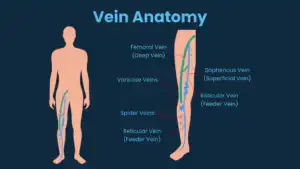
Before we get into varicose veins, we have to learn a little about veins themselves.
Your veins carry blood up toward the heart with help from your muscles, gravity, and by pumping your feet(1).
Vein walls consist of three layers – intima, media, and adventitia.
- The venous intima, the innermost layer, helps blood pass through your body smoothly(2).
- The venous media refers to the middle layer. This layer consists of elastic tissues and muscle(2), which allows the vein to change size without changing pressure(1).
- The adventitia layer is the outermost layer, made of collagen, elastic fibers, and fibroblasts(1). This gives the veins their shape and support(2).
Now that we understand the basics let’s learn more about what causes issues in our veins.
What Causes Vein Disease?
Varicose veins are an example of venous insufficiency when your body has trouble sending blood back to the heart(3).
Many factors can cause vein damage, but too much pressure is often the culprit(4).
Healthy veins pump blood up to your heart. But when veins struggle to do so, the pressure in these veins increases, leading to stretching, splitting, or thinning(5) of the vein structures.
Sometimes, pressure from standing or sitting means the lower limbs are inactive, which can increase venous hypertension since the muscles are not pumping blood upward.
The mechanisms continue to impact each other, leading to blue or purple veins that protrude from beneath the skin: varicose veins.
Varicose veins occur mainly in the lower extremities because these veins are located furthest from the heart. They are often superficial, deep, or perforating veins(1).
Risk Factors for Varicose Veins
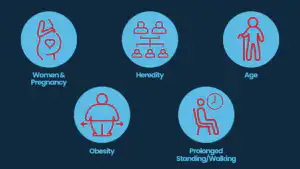
Who is most likely to develop this condition? There are a few risk factors to consider.
Hormones and Pregnancy
Large amounts of estrogen can cause veins to swell, putting you at risk for varicose veins.
Pregnancy hormones can also impact vein health. Progesterone causes venous dilation, which can weaken veins(10). Weight gain also adds additional pressure(11).
Lifestyle
If your job has you on your feet or sitting at a desk all day, you may be more at risk for developing this condition. Smoking can also increase your risk: it damages the walls of veins and can cause inflammation(8).
Obesity
Obesity puts more weight on the lower limbs, which can lead to venous hypertension(2).
Deep Vein Thrombosis (DVT)
A history of deep vein thrombosis is also a risk factor for developing varicose veins. Deep vein thrombosis, or DVT, occurs when a blood clot forms in the deep veins(2).
Age
As we age, our bodies experience wear and tear, including our veins. The valves become less efficient, leading to the possibility of varicose veins(2).
Genetics
If a family member has varicose veins, you might develop them too. Certain genes impact vein function, making veins more susceptible to damage(12). Other diseases in the family increase your risk of developing varicose veins. Examples include Ehlers-Danlos syndrome or Klippel-Trenaunay syndrome(12).
Signs and Symptoms of Varicose Veins
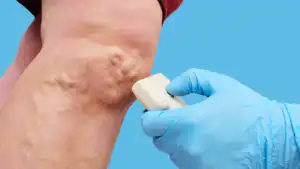
Varicose veins look blue or purple and may bulge from under the skin.
In addition to their appearance, you may feel heaviness, burning, or throbbing in your legs or notice skin changes in the area. You might also notice pain after prolonged sitting or standing.
Getting a Diagnosis
If you suspect you have varicose veins, it’s time to talk to your doctor. They will evaluate your medical history and perform a physical exam.
Imaging is essential when diagnosing this condition.
Venous duplex ultrasound scan: This is a safe, non-invasive diagnostic scan that uses sound waves to measure the speed of blood flow in the lower limbs(13).
When are Varicose Veins Dangerous?
Emergency
Bleeding varicosity that has eroded the skin. Go to the nearest hospital or doctor as soon as possible to get treatment for your varicose veins. They need to treat the varicosity immediately.
Urgent
Varicosities that have bled and may bleed again. If a vein bleeds again while applying pressure, seek a consultation or a referral to a doctor.
Preventing Varicose Veins
There is no way to prevent varicose veins fully, but there are measures you can take to reduce your chances of developing them in the first place:
Exercise
Exercise improves blood flow in your legs as leg muscles pump. Your calves squeeze your veins, pushing blood to the heart. Flexing these muscles helps keep veins healthy.
Weight management
If you are overweight, losing weight can lessen the burden on the lower extremities and reduce venous hypertension.
Elevate your legs
Lifting your legs up decreases the pressure that gravity causes and helps blood flow back to the heart.
Frequently changing your sitting or standing position
Avoid too much sitting or standing. Changing your position triggers the pumping action of the muscles on your legs.
Treating Varicose Veins
There are several treatment options available for varicose veins:
Compression Therapy
Compression therapy is essential for treating varicose veins. This is often the first step patients take. Pressure is applied to the leg to reduce venous insufficiency(4).
Radiofrequency Ablation (RFA)
Radiofrequency Ablation is a minimally invasive treatment for diseased veins. Using ultrasound guidance, a small catheter delivers heat to seal the affected vein, allowing blood to reroute through healthy veins. The procedure typically takes 20–40 minutes, is performed as an outpatient treatment with same-day return to normal activities, and provides a long-lasting solution for many patients. The number of treatments depends on the extent of vein disease.
Varithena
Varithena® is a minimally invasive treatment for varicose veins and venous reflux disease. A specialized foam is injected into the affected vein, causing it to close so blood can flow through healthier veins. The procedure takes about 30 minutes, requires little downtime, and many patients notice symptom relief within a few days. It can help reduce pain, swelling, and visible varicose veins while preventing progression to more serious vein disease.
Microphlebectomy
Microphlebectomy is a minimally invasive procedure used to remove large, bulging varicose veins through tiny openings in the skin. The affected veins are gently removed, providing immediate improvement in their appearance while helping relieve symptoms such as aching, heaviness, and swelling. The procedure is performed on an outpatient basis, requires little downtime, and most patients return to normal activities within a day or two. The number of treatments depends on the extent of the varicose veins.
Conclusion
AMS Vascular is your go-to vein health specialist. Our experts use the latest medical technology and apply treatment with a patient-first approach. Ready to treat your varicose veins? Book a consultation today and take the first step toward a healthier you!
References
- Brunicardi F., Andersen D.K., Billiar T.R., Dunn D.L., Kao L.S., Hunter J.G., Matthews J.B., & Pollock R.E.(Eds.), (2019). Schwartz’s Principles of Surgery, 11e. McGraw-Hill. https://accesssurgery.mhmedical.com/content.aspx?bookid=2576§ionid=208294867
- Piazza, G. (2014). Varicose veins. Circulation: Clinical Summaries. 130(7), 582–587. https://doi.org/10.1161/CIRCULATIONAHA.113.008331
- Tucker, W.D., Arora Y., & Mahajan, K. (2020) Anatomy, Blood Vessels. In: StatPearls [Internet]. Treasure Island (FL): StatPearls Publishing. https://www.ncbi.nlm.nih.gov/books/NBK470401/
- Youn, Y. J., & Lee, J. (2019). Chronic venous insufficiency and varicose veins of the lower extremities. The Korean journal of internal medicine, 34(2), 269–283. https://doi.org/10.3904/kjim.2018.230
- Bergan JJ, Schmid-Schönbein GW, Smith PD, Nicolaides AN, Boisseau MR, Eklof B. Chronic venous disease.N Engl J Med. 2006; 355:488–498.
- Recek C. (2013). Calf pump activity influencing venous hemodynamics in the lower extremity. The International journal of angiology : official publication of the International College of Angiology, Inc, 22(1), 23–30. https://doi.org/10.1055/s-0033-1334092
- Ciardullo, A.V., et al. (2000). High endogenous estradiol is associated with increased venous distensibility and clinical evidence of varicose veins in menopausal women. Journal of vascular surgery. 32(3), 544-549. https://doi.org/10.1067/mva.2000.107768
- Gourgou, S., Dedieu, F., & Sancho-Garnier, H. (2002) Lower Limb Venous Insufficiency and Tobacco Smoking: A Case-Control Study. American Journal of Epidemiology. 155(11), 1007–1015. https://doi.org/10.1093/aje/155.11.1007
- Labropoulos, N. (2019). How Does Chronic Venous Disease Progress from the First Symptoms to the Advanced Stages? A Review. Adv Ther 36, 13–19. https://doi.org/10.1007/s12325-019-0885-3
- Mashiah, A., Berman, V., Thole, H. H., Rose, S. S., Pasik, S., Schwarz, H., & Ben-Hur, H. (1999). Estrogen and progesterone receptors in normal and varicose saphenous veins. Cardiovascular surgery (London, England), 7(3), 327–331. https://doi.org/10.1016/s0967-2109(98)00132-x
- Kominiarek, M. A., & Peaceman, A. M. (2017). Gestational weight gain. American journal of obstetrics and gynecology, 217(6), 642–651. https://doi.org/10.1016/j.ajog.2017.05.040
- Anwar, M.A., Georgiadis, K.A., Shalhoun, J., Lim, C.S., Gohel, M., & Davies, A.H. (2012). A review of familial, genetic, and congenital aspects of primary varicose vein disease. Circulation: Cardiovascular Genetics. 5(4), 460-466. https://doi.org/10.1161/CIRCGENETICS.112.963439
- Cheung M.E., & Firstenberg M.S. (2020) Duplex Ultrasound. Treasure Island (FL): StatPearls Publishing. https://www.ncbi.nlm.nih.gov/books/NBK459266/
- Hwang J. Y. (2017). Doppler ultrasonography of the lower extremity arteries: anatomy and scanning guidelines. Ultrasonography (Seoul, Korea), 36(2), 111–119. https://doi.org/10.14366/usg.16054
- Moorthy R. S. (2002). Doppler ultrasound. Medical journal, Armed Forces India, 58(1), 1–2. https://doi.org/10.1016/S0377-1237(02)80001-6
- Tisi P. V. (2011). Varicose veins. BMJ clinical evidence, 2011, 0212.
- Campbell B. (2006). Varicose veins and their management. BMJ (Clinical research ed.), 333(7562), 287–292. https://=doi.org/10.1136/bmj.333.7562.287
- Czysz A., & Higbee S.L.(2020) Superficial Thrombophlebitis. StatPearls [Internet]. Treasure Island (FL): StatPearls Publishing. https://www.ncbi.nlm.nih.gov/books/NBK556017/
- Aaron, K. J., & Sanders, P. W. (2013). Role of dietary salt and potassium intake in cardiovascular health and disease: a review of the evidence. Mayo Clinic proceedings, 88(9), 987–995. https://doi.org/10.1016/j.mayocp.2013.06.005